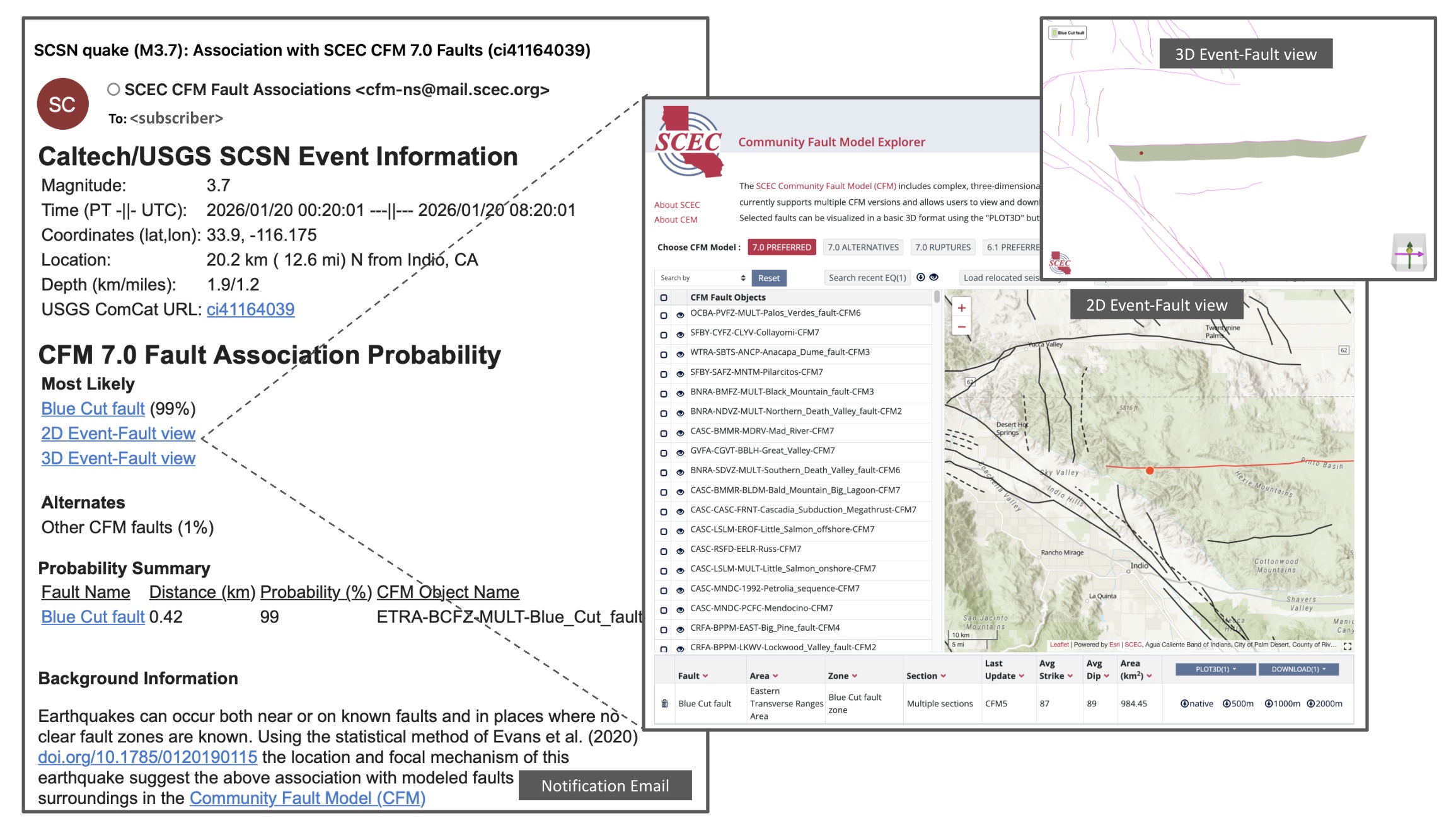
The broader geographic scope and increased number of fault representations in the SCEC CFM 7.0 contribute directly to the improved association rate, ensuring that more earthquakes can be linked with known fault structures.
How the Statistical Matching Works
Launched in 2020, the service was designed to help researchers quickly identify which faults are most likely associated with recent earthquakes—crucial information when they’re briefing the public right after shaking is felt. The service utilizes three-dimensional spatial relationships between event locations and fault geometries to generate probabilistic associations, based on methods described in Evans et al. (2020).
The original version of the service, developed by researchers at Harvard University and Caltech in collaboration with SCEC, introduced a near real-time statistical method to estimate which faults in the CFM were most likely associated with earthquakes. The approach combined three key factors: the earthquake’s proximity to faults, the alignment of its movement (focal mechanism) with fault orientation, and patterns of nearby and recent seismic activity.
To validate the system, Evans et al. (2020) used a suite of earthquakes known to have likely occurred on mapped faults, ensuring the data came from events after the release of CFM version 2.0 to avoid bias. The team implemented the method as an R script and applied it to all ≥M3.0 events in the SCSN catalog using CFM 5.2. For each event, the system produces the five most likely fault associations along with the probability that the event was not linked to any fault in the model. The current upgrade applies this same validated algorithm to CFM 7.0 faults, but now adds links to 2D and 3D interactive visualizations using the CFM Explorer.
“From the beginning, we targeted both a robust, statistical model well tuned to past seismicity and its eventual deployment as an objective, near-real-time service to support operational communications.” said Andreas Plesch, research scientist at Harvard University.
Technical Implementation and Automation
The fault association service builds on the seismic monitoring and data archiving systems maintained by the SCSN and Southern California Earthquake Data Center (SCEDC). The SCSN provides continuous, real time earthquake monitoring across Southern California using data from more than 550 seismic stations. These detections are rapidly processed and sent to the SCEDC, which curates a 120 terabyte archive spanning decades of regional seismicity to support long term research, validation, and model development. Leveraging this operational backbone, the CFM earthquake to fault association service integrates SCSN’s real time event stream with SCEDC’s historical datasets to deliver near–real time associations between earthquakes and faults in the SCEC CFM.
“The CFM has undergone several major updates since the service was first developed, so our goal was to automate integration with both current and future CFM versions. Because the SCSN detects earthquakes outside the CFM’s geographic footprint, we also implemented a spatial filter to prevent the service from processing those events.” said Scott Marshall.
The service is now incorporated into Caltech’s AQMS workflow through the Eq2CFM wrapper script, which automatically generates and distributes fault association summaries within minutes of an event.
“The fault association service shows what becomes possible when real time monitoring and long term data curation work hand in hand,” said Ellen Yu, SCSN/SCEDC Products Manager. “The SCSN and SCEDC pipelines were built to deliver reliable, high quality seismic information every minute of every day, and it’s exciting to see that foundation enabling new tools that directly support the community. This kind of synthesis is only possible because of dedicated staff at SCEC, SCSN, and SCEDC.”
Through this automated pipeline, the CFM earthquake-to-fault association service consistently delivers timely, actionable information, providing a dependable foundation for both research and operational applications.
Subscribe to Receive CFM Fault Association Notifications
SCEC community members can opt in to receive email notifications within minutes of any ≥M3 event in Southern California. Log in to your SCEC.org account, update your profile, check the box for “CFM Fault Association Notifications” under Mailing List Subscriptions, and click SAVE at the bottom of the page. Users may unsubscribe at any time by revisiting their profile settings.
Collaboration and Contributors
The Community Fault Model (CFM) Earthquake-to-Fault Association Service is a joint effort between the Southern California Earthquake Data Center (SCEDC) at Caltech, the Statewide California Earthquake Center (SCEC), Harvard University, and Appalachian State University. Key contributors include Andreas Plesch and John H. Shaw (Harvard), Scott T. Marshall (Appalachian State), Mei-Hui Su (SCEC), Egill Hauksson and Ellen Yu (Caltech/SCEDC).
Select Publications and Presentations
These select publications and presentations showcase recent advances in SCEC Community Fault Model development:
- Plesch, A., Marshall, S. T., Shaw, J. H. (accepted). The Community Fault Model (v. 6.1) for Southern California. Bulletin of the Seismological Society of America. SCEC Contribution 14391
- “SCEC Community Fault Model (CFM)”. Statewide California Earthquake Center, https://www.scec.org/science/community-fault-model/. Accessed February 9, 2026.
- Marshall, S. T., Plesch, A., & Shaw, J. H. (2025, 01) The SCEC Community Fault Model v7.0. Presentation at the 2025 Northern California Earthquake Hazards Workshop. (see video)
- Plesch, A., Marshall, S. T., Shaw, J. H., Su, M., Maechling, P. J., Huynh, T. T., & Pauk, E. (2024, 09). CFM 7.0: Integration of southern, central, and northern California 3d fault representations into a uniform, statewide Community Fault Model. Poster Presentation at 2024 SCEC Annual Meeting. SCEC Contribution Number 13870
- “Know your faults — SCEC CFM fault association notifications”. Southern California Earthquake Center (Archive). https://southern.scec.org/article/619. Accessed February 1, 2026.
- Evans, W.S., A. Plesch, J. H. Shaw, N. L. Pillai, E. Yu, M. Meier, and E. Hauksson (2020). A statistical method for associating earthquakes with their source faults in southern California, Bulletin of the Seismological Society of America, 110 (1): 213–225, doi 10.1785/0120190115. SCEC Contribution 9057.
- Plesch, Andreas, et al. “Community Fault Model (CFM) for Southern California.” Bulletin of the Seismological Society of America, vol. 97, no. 6, 2007, pp. 1793–802, doi:10.1785/0120050211. SCEC Contribution 1134
Acknowledgements
This research was supported by the Statewide California Earthquake Center (Contribution No. 15012) and Harvard University. SCEC is funded by NSF Cooperative Agreement EAR-2225216 and USGS Cooperative Agreement G24AC00072.