By: Ahmed Elbanna
Published August 20, 2026
At last year’s SCEC Annual Meeting, we began discussing a new vision for the future of earthquake system science built around four elements: cyber-physical fusion, transdisciplinary collaboration and alliance with the engineering community, AI-enabled science, and re-imagined education and workforce development.
This vision builds on a longstanding strength of SCEC as a collaboration: shared scientific direction is shaped and advanced through the ideas, expertise, and initiative of the SCEC community. The new Team Science framework gives us an opportunity to strengthen this reciprocal relationship as we tackle increasingly interconnected problems in earthquake science.
The 2026 SCEC Collaboration Plan for Technical Activity Groups (TAGs) represents the culmination of nearly a year of community planning, coordination, and proposal development under this new framework. The Board of Directors and SCEC’s sponsors have approved a portfolio of twelve Technical Activity Groups designed to advance the scientific and societal objectives of the 2026 Science Plan.
Building the 2026 TAG Portfolio
This effort began in November 2025, when SCEC received nineteen Letters of Intent describing potential TAG concepts involving approximately 180 participants. Following feedback provided by the SCEC Science Steering Committee (SSC), TAG leaders were encouraged to identify opportunities for coordination and collaboration. By the May 8 proposal deadline, teams had expanded and new partnerships had formed, resulting in fourteen full proposals from 48 investigators involving 269 project participants. Several initial concepts evolved into broader efforts capable of serving as hubs for community coordination and scientific synthesis. This served as an early expression of the Team Science approach.
On June 4–5, 2026, the SCEC Proposal Review Committee (PRC) met to evaluate proposals using a new rubric designed specifically for Technical Activity Groups. In addition to scientific significance, the review considered anticipated contributions to SCEC products and infrastructure, milestones and deliverables, management and coordination, community engagement, feasibility, and TAG characteristics, as well as balance across scientific themes, infrastructure, workforce development, and SCEC’s broader mission.
Following PRC review, the SCEC management team aligned recommendations with available sponsor resources and priorities, resulting in twelve TAGs representing $786,752 in planned investments. The Board of Directors approved the recommended TAG portfolio on June 19, and sponsoring agencies gave final approval by the end of June. The TAGs are now moving into implementation.
The 2026 Collaboration Plan supports the following twelve Technical Activity Groups:
- ShakeOut Scenario
- The Next Generation 3D Community Fault Model for California (CFM)
- Understanding Natural Recurrence of Earthquakes and Slip over Time (UNREST)
- Community Stress Drop Validation Study (STRESS)
- Integrating Community Research into a Consensus Geodetic Model (CGM)
- Next-Generation Ground Motion Simulation, Validation, and Utilization (GM-SVU)
- Advancing Simulations of Sequences of Earthquakes and Aseismic Slip (SEAS)
- Sierra Earthquake Risk Reduction (SiERRa)
- Multi-scale Community Velocity Model (CVM)
- Creep Rate, Episodicity, and Earthquake Potential (CREEP)
- Shallow Earth Materials (SEM)
- Northern California Cascadia–San Andreas Transition (NORCAT)
Together, these twelve TAGs involve hundreds of participants and collectively advance all seven objectives of the 2026 Science Plan through coordinated research, community infrastructure development, workforce training, and stakeholder engagement. They address the Center’s major activities including: Strengthening California’s Community Earth Models, Advancing Hazard Scenarios and Ground-Motion Science, Advancing Earthquake Forecasting and Earthquake Cycle Science, Supporting Resilience, Workforce Development, and Community Engagement. Viewed as a whole, the portfolio reveals connections that extend beyond these individual areas of activity and across several elements of SCEC’s earthquake system science vision.
An Emerging Earthquake System Science Ecosystem
The potential of the 2026 portfolio becomes clearer when we look across the TAGs. Data, models, methods, and expertise developed through one activity can inform and strengthen work in others. The diagram below illustrates several examples of this emerging synergy and their relationship to elements of SCEC’s earthquake system science vision.
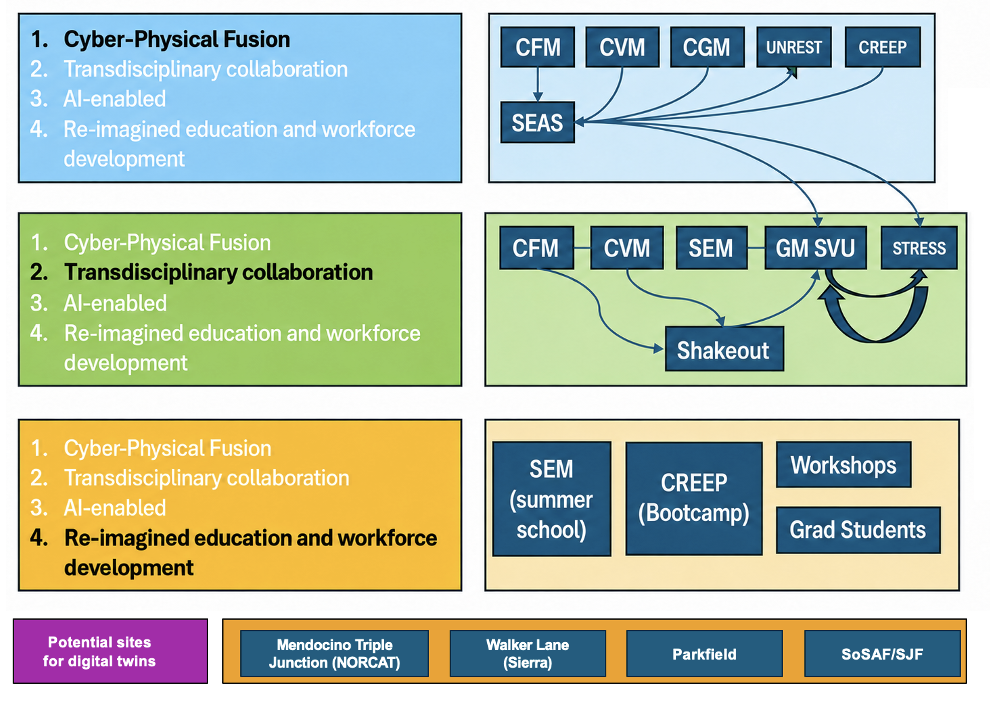
For cyber-physical fusion, CFM, CVM, CGM, UNREST, CREEP, and SEAS connect observations, representations of the physical system, and computational models. These scientific dependencies and opportunities for information exchange begin to create the ingredients needed for building dynamic digital twins of California fault zones.
For transdisciplinary collaboration, Community Earth Models such as CFM and CVM, together with SEM efforts to characterize shallow Earth materials, provide essential inputs for ground-motion simulations within GM-SVU. GM-SVU develops synthetic ground-motion datasets and validation metrics that connect with STRESS and aims to increase the use of simulated ground motions in engineering applications, building on SCEC computational hazard products including CyberShake, the Broadband Platform, OpenSHA, and the UGMS tool.
The ShakeOut Scenario TAG provides a distinct but complementary integrative problem spanning Earth science, engineering, social sciences, and policy, with synergies across community Earth models, dynamic rupture simulations, synthetic ground motions, engineering impacts, and population dynamics. The feedback loops suggest that results from one activity can expose uncertainties, identify new questions, and motivate improvements in another, allowing advances and lessons to propagate across the portfolio. The opportunity now is to nurture the most promising connections while preserving the scientific creativity and community-driven character that allowed them to develop.
From Connections to New Scientific Opportunities
These connections also point toward opportunities to bring multiple SCEC capabilities together around consequential scientific problems and fault systems. Several TAGs and workshops have identified opportunities for data fusion and model integration that form a pathway toward constructing digital twins for California fault zones.
NORCAT focuses on the Mendocino Triple Junction, the region with the highest seismic activity in California, while SiERRa focuses on Walker Lane, a region with significant seismic hazard and risk for critical infrastructure. Parkfield presents another compelling opportunity. As one of the best-instrumented fault zones in the world, with quasiperiodic M6.0 earthquakes and the potential to trigger an 1857-scale event on the San Andreas Fault, it is a credible candidate for continuous assimilation of data and models to advance and test short-term earthquake forecasting.
In Southern California, the ShakeOut TAG focuses on the Southern San Andreas fault and the related tectonic setting encompassing the San Jacinto fault and the Cajon pass. This effort lays a foundation for similar observational and modeling campaigns in Southern California and provides a blueprint for future Center activities around other critical fault zones in Northern California, including the Hayward Fault.
Realizing these opportunities also depends on developing a community able to work across disciplinary and methodological boundaries. This is already appearing in the re-imagining of education and workforce development. The SEM field school, CREEP bootcamp, workshops, and graduate-student participation in all TAGs provide opportunities for students and early-career researchers to engage directly with SCEC-supported science. Training thus becomes part of the research enterprise itself, exposing the next generation to multiple components of earthquake system science rather than isolated disciplinary problems.
Looking Ahead: Strengthening the Emerging Portfolio
The 2026 SCEC TAG portfolio also highlights two areas that should help guide our next steps, showing both where community-led activities are gaining momentum and where additional coordination or shared capabilities can strengthen SCEC’s broader earthquake system science vision.
The first is AI-enabled science. Although no 2026 TAG focuses exclusively on AI-enabled earthquake science, many incorporate AI and machine-learning approaches, suggesting that these capabilities are already permeating the portfolio. The Science Steering Committee (SSC) and SCEC headquarters team will work together to demonstrate the potential of human-centered AI as a scientific enabler, a democratizer of access to advanced tools and data, and an amplifier of human expertise. Rather than treating AI as a separate activity, the opportunity is to develop it as a capability that strengthens science across the Center.
The second area is post-earthquake science response. Although no TAG is specifically organized around response, several are developing relevant capabilities. SEM and CREEP include training in data gathering, evaluation, field surveying, and related skills that could be rapidly mobilized, while Community Earth Models provide information needed to interpret an unfolding sequence and support rapid simulations. SCEC headquarters will continue to provide rapid communication and information sharing through response.scec.org and coordinate community science activities, including observations and analyses, rapid modeling and aftershock forecasting, and the development of RAPID proposals following significant earthquakes in California. Strengthening SCEC’s response capability will require connecting these existing resources and emerging community capabilities within a more comprehensive framework.
Turning Connections into Collaboration
The next step is to turn these emerging scientific connections into active collaboration across the SCEC community, and the 2026 SCEC Annual Meeting provides an immediate opportunity to do so.
The newly launched SCEC TAGs will provide an important thread throughout the meeting. Each TAG will give a brief overview in a plenary session and present a poster describing its objectives, structure, and planned activities, providing opportunities to recruit participants, strengthen connections, identify new synergies, and begin translating ideas into action.
We encourage the SCEC community not only to learn about individual TAGs, but also to identify connections across activities, contribute ideas and expertise, and help shape how these efforts develop. Their success will depend on continued partnership among TAG leaders, SCEC leadership and staff, and the broader community as we work together to shape an increasingly integrated research agenda and strengthen the science-to-society arc.
The 2026 TAG portfolio provides a new framework for something that has long been central to SCEC: bringing shared scientific direction together with the expertise, creativity, and participation of the community. As these activities move into implementation, we invite the entire SCEC community to help make the connections that will shape the next phase of earthquake system science.